
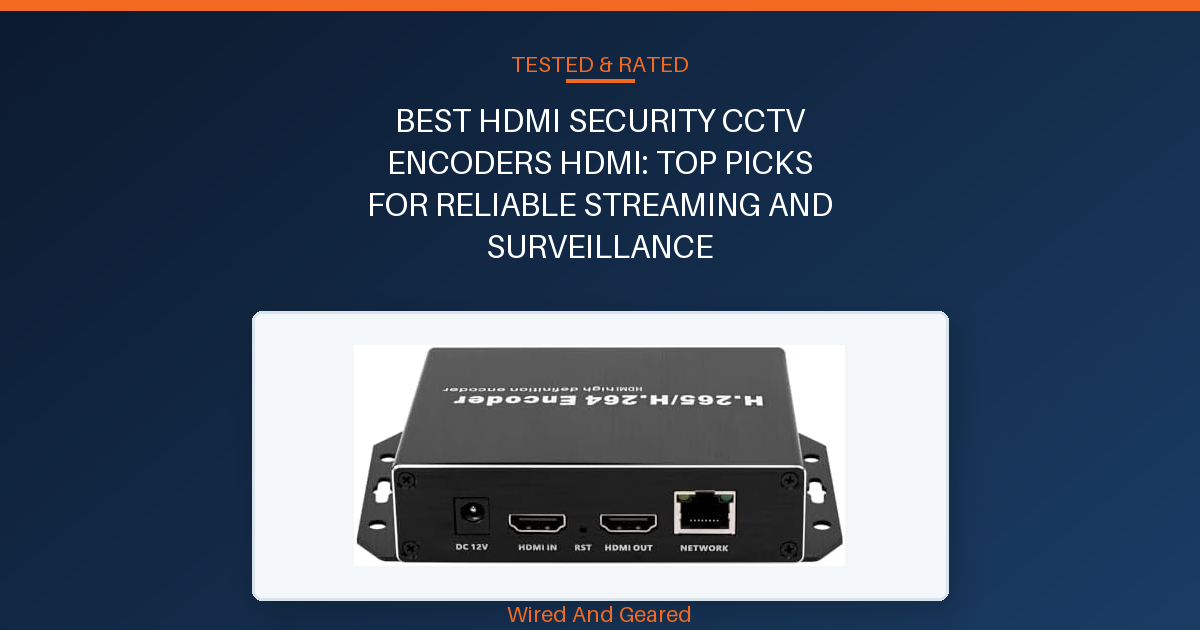
A reliable HDMI encoder is essential for smooth CCTV surveillance and secure live streaming. The right model lets you monitor locally via HDMI and stream efficiently to remote devices or platforms.
This guide targets buyers setting up professional CCTV systems, live streaming events, or integrating surveillance with network video recorders. It covers encoders that work with PoE, SD card backup, and multiple streaming protocols.
Each product here has been vetted for real-world performance, compatibility, and ease of setup. Skip generic models with weak documentation or spotty reliability; these picks excel in demanding environments.
Read the side-by-side criteria to see which encoder fits your needs best, whether you prioritize local monitoring, multi-platform streaming, or advanced broadcast options.
// We test hands-on, buy what we cover, and never let commissions shape our picks.
| Product | Resolution | Codec Support | Power Options | SD Card Slot | |
|---|---|---|---|---|---|
| EXVIST H.265 1080P PoE HDMI Video Encoder w/Loopout | 1080P | H.265/H.264 | PoE or DC 12V | Up to 128GB | See on Amazon |
| 1080P60 HDMI Video Encoder, H.265/H.264 | 1080P60 | H.265/H.264 | DC 12V | No | See on Amazon |
| EXVIST H.265 1080P PoE HDMI to Network Encoder W/SD Card | 1080P | H.265/H.264 | PoE or DC 12V | Up to 128GB | See on Amazon |
| 4K HDMI Encoder with 4 Channel Output | 4K30 or 4×1080P30 | H.265/H.264/MJPEG | DC 12V | No | See on Amazon |
| HD HEVC H.265 MPEG4 H.264 4K HDMI to Video Streaming IPTV | 4K30, 2K120 | H.265/H.264/MPEG4 | DC 12V | No | See on Amazon |
EXVIST H.265 1080P PoE HDMI Video Encoder w/Loopout
Dual power options make installation straightforward, whether you’re running PoE for up to 140 meters or using DC power. The HDTV Loop-Out is a practical inclusion, letting you check your live feed locally before pushing it to the network, which is crucial for surveillance setups where video quality and framing matter.
Encoding uses both H.265 and H.264, ensuring broad compatibility and efficient bandwidth usage even on limited networks. Direct SD card recording means you can capture footage without a dedicated NVR or PC, ideal for standalone deployments or backup scenarios.
The web-based interface is designed for easy configuration of streaming protocols like RTSP, TS, and UDP, so integration with most CCTV software is smooth. Reviewers consistently point out strong build quality and a price that’s reasonable for the features offered.
The main trade-off is the lack of advanced documentation and support, which means you need some technical confidence to configure streaming or troubleshoot. PoE switches aren’t included, so factor that into your total cost if you’re deploying multiple units.
This encoder is a solid pick for installers or small businesses wanting versatile, direct-to-network hardware.
Strengths
- HDTV Loop-Out enables real-time local monitoring
- Dual PoE and DC power options for flexible installation
- Efficient H.265/H.264 encoding reduces bandwidth
- Direct SD card recording for standalone operation
- Wide protocol compatibility (RTSP, TS, UDP, DDNS)
Trade-offs
- PoE switch not included
- Documentation is basic
- Requires technical setup for network streaming
1080P60 HDMI Video Encoder, H.265/H.264
Hardware H.265/H.264 encoding at 1080P60 ensures sharp video and efficient bandwidth, making it suitable for live events, security, or whole-home streaming. Setup is browser-based and doesn’t require additional software, but initial network configuration can be tricky if your subnet differs from the default, and basic networking skills are needed to get its full potential.
Once configured, it handles continuous operation without crashes or stalls, giving you a reliable appliance for critical feeds. The palm-sized design fits easily behind displays or in racks, and low power draw means 24/7 usage is practical.
Audio support includes embedded HDMI and a 3.5mm input, so you can customize your feed for branding or security with OSD overlays. Protocol coverage is broad (RTSP, RTMP, SRT, HLS, WebRTC), so you can stream to nearly any platform or device, and latency can be tuned to under half a second for responsive viewing.
The main frustrations are the lack of a mounting thread and sparse documentation. The setup page must be accessed via HTTP (not HTTPS), and some advanced streaming configurations can stump novice users.
This is not a plug-and-play device; those unfamiliar with IP settings or streaming protocols will struggle. Technical support is responsive, but you’ll need to be comfortable with troubleshooting.
Strengths
- Broadcast-quality 1080P60 streaming with H.265/H.264
- Broad protocol support for flexible streaming
- Compact, low-power design for discreet deployment
- OSD overlay and audio input customization
- Reliable operation with minimal latency
Trade-offs
- Initial network configuration is complex
- Documentation is minimal
- No mounting thread for standard equipment
EXVIST H.265 1080P PoE HDMI to Network Encoder W/SD Card
Dual-power (PoE and DC) makes installation easy in varied environments, and the SD card slot enables local recording up to 128GB. Streaming protocols cover RTSP, SRT, TS, and DDNS, so it works with most network video systems and even unconventional setups like home automation screens.
The web interface is cross-browser compatible, allowing remote management and parameter adjustment from Chrome, Edge, or Firefox. Stream quality is generally good, with minimal lag and reliable video capture.
Audio can be a problem, with some clients dropping the feed due to bad AAC packets unless transcoding is used. Firmware updates are difficult to find, and the online help menus often show options that don’t exist, leading to confusion during setup and troubleshooting.
While the price is low for the feature set, reliability is a concern for demanding or mission-critical uses. Some units fail during initial testing, and the support is limited.
If you need a basic, affordable encoder for occasional streaming or simple network integration, this is a reasonable pick, but it’s not suitable for high-stakes surveillance or complex workflows.
Strengths
- Affordable for the feature set
- Flexible PoE and DC power options
- Direct SD card recording for local backup
- Wide streaming protocol support
- Easy browser-based configuration
Trade-offs
- Documentation and firmware support are poor
- Audio streaming issues with some clients
- Reliability concerns for critical applications
4K HDMI Encoder with 4 Channel Output
Output flexibility is the standout: stream either 1×4K30 or 4×1080P30 channels depending on your workflow. The OLED display shows real-time IP, resolution, and encoding status for quick diagnostics, and HDMI Loop-Out lets you monitor locally as you stream.
Protocol support covers RTMP, RTMPS, SRT, RTSP, HTTP, and full ONVIF compatibility, so integration with broadcast, IPTV, or surveillance systems is smooth. Advanced features include image flip, customizable OSD overlays, and audio-only encoding, which are ideal for multi-screen displays, copyright protection, or branded streaming.
The 3-year warranty and 24/7 support add peace of mind for mission-critical deployments. Reviewers highlight its protocol versatility and reliability, with no reported hiccups in streaming or integration.
The trade-off is price, which is higher than single-channel models, and setup requires careful EDID selection to enable 4K input. This is not for casual home users or simple CCTV setups; it’s for professionals who need multi-feed streaming, broadcast-grade monitoring, and strong support.
Strengths
- Selectable 4K or quad 1080P output
- OLED display for real-time status monitoring
- HDMI Loop-Out for local verification
- Extensive protocol support including ONVIF
- Advanced OSD and image flip features
- 3-year warranty with 24/7 support
Trade-offs
- Higher price point
- Setup requires EDID adjustment for 4K
- Overkill for basic home or CCTV use
HD HEVC H.265 MPEG4 H.264 4K HDMI to Video Streaming IPTV
Dual H.265/H.264 encoding chips deliver smooth 4K UHD at 30fps or up to 120fps in lower resolutions, with stable network performance and low latency. It can output four streams simultaneously across diverse protocols, RTMP, RTSP, SRT, HLS, and more, making it suitable for live events, presentations, and multi-location streaming.
Customizable overlays, cropping, and audio mixing allow for branded, professional streams without needing extra hardware. Setup is straightforward once instructions are followed, and firmware updates resolve minor output issues.
The device is compatible with computers, mobile phones, and most streaming platforms, offering real-time monitoring and management. Reviewers especially praise removing the need for a dedicated computer in their workflow, boosting reliability and simplifying production.
The main drawbacks are the lack of an on/off switch (for circuit cooling), default DHCP disabled (requiring manual IP setup), and no region-specific power adapters. Audio must always be present for YouTube streams, and some color output quirks may require firmware updates.
This unit is best for enterprise or professional users needing simultaneous streams, but casual buyers may find setup and network integration challenging.
Strengths
- Dual H.265/H.264 encoding for efficient 4K streaming
- Simultaneous multi-protocol output
- Customizable overlays and audio mixing
- Stable, low-latency transmission
- Removes need for dedicated computer in workflow
- Lifetime warranty and technical support
Trade-offs
- No on/off switch for cooling
- Default DHCP disabled, manual IP setup required
- No region-specific power adapters included
01Codec and Compression Support
H.265 (HEVC) and H.264 codecs determine stream quality and bandwidth use. If your surveillance network needs high efficiency and compatibility, prioritize models with both codecs. Avoid older devices that only support H.264, as they limit future upgrades and increase storage demands.
02Protocol Flexibility
RTSP, RTMP, SRT, HTTP, and HLS protocols are vital for integration with NVRs, live platforms, and automation. Pick an encoder with multiple protocol options to avoid hassle connecting to different systems. Models with limited protocol support restrict expansion and may require additional hardware.
03HDMI Loopout and Local Monitoring
HDMI loopout allows real-time local display while streaming, critical for CCTV setups needing on-site monitoring. If you need local viewing as well as network streaming, choose encoders with built-in loopout. Skipping loopout means sacrificing easy local access and troubleshooting.
04Power Options and SD Card Backup
PoE (Power over Ethernet) simplifies installation and reduces cable clutter, while SD card slots enable local recording as a backup. Look for these features if you want fast setup and redundancy. Models lacking PoE can complicate installation, and missing SD backup risks losing footage during network outages.
05Build Quality and Documentation
Solid hardware and clear documentation prevent setup issues and downtime. Reliable brands update firmware and support new platforms, while poor build quality causes instability. Avoid models with weak instructions or questionable reliability, especially for mission-critical CCTV applications.