
Finding the right coaxial cable splitter can make or break your internet speed and signal reliability. If you depend on high-speed internet for work, streaming, or gaming, a poor-quality splitter will drag down performance and cause frustrating interruptions.
This guide is for anyone setting up home internet, especially those using modern cable modems or MoCA-enabled networks. It covers what actually matters: signal loss, frequency range, build quality, and compatibility with the latest standards.
Each splitter here was chosen for its ability to handle high-speed data, not just basic TV signals. You’ll see clear pros and cons, so you can match the splitter to your setup and avoid common pitfalls.
Scan the takeaways and buying guide below to save time. The winner is named up front, and the comparison table breaks down the differences that matter for internet speed and reliability.
TL;DR: The 2 Way Coaxial Cable Splitter (index 1) is the best coaxial cable splitter for high speed internet, offering MoCA 2.5 and 3.0 support, stable speeds, and clean signal. The BAMF 2-Way Splitter (index 4) is a strong runner-up, performing well for both TV and high-speed data, but lacks the broader MoCA compatibility of the winner.
Our overall best pick: 2 Way Coaxial Cable Splitter →
| Product | Frequency Range | Number of Outputs | Connector Type | Power Pass | |
|---|---|---|---|---|---|
| 2 Way Coaxial Cable Splitter | 10-2602 MHz | 2 | Nickel-plated RG6/RG59 | Yes | See on Amazon |
| GE Digital 2-Way Coaxial Cable Splitter | 5-2500 MHz | 2 | Gold-plated RG6 | No | See on Amazon |
| GE Digital 4-Way Coaxial Cable Splitter | 5-2500 MHz | 4 | Gold-plated RG6/RG59 | Yes | See on Amazon |
| Digital 8-Way Coaxial Cable Splitter Compatible with RG6 | 5-2400 MHz | 8 | Galvanized/nickel RG6/RG59 | Yes | See on Amazon |
| BAMF 2-Way Coax Cable Splitter – Bi-Directional MoCA 5-2300 | 5-2300 MHz | 2 | Nickel-plated RG6/RG59 | Partial (splitter only) | See on Amazon |
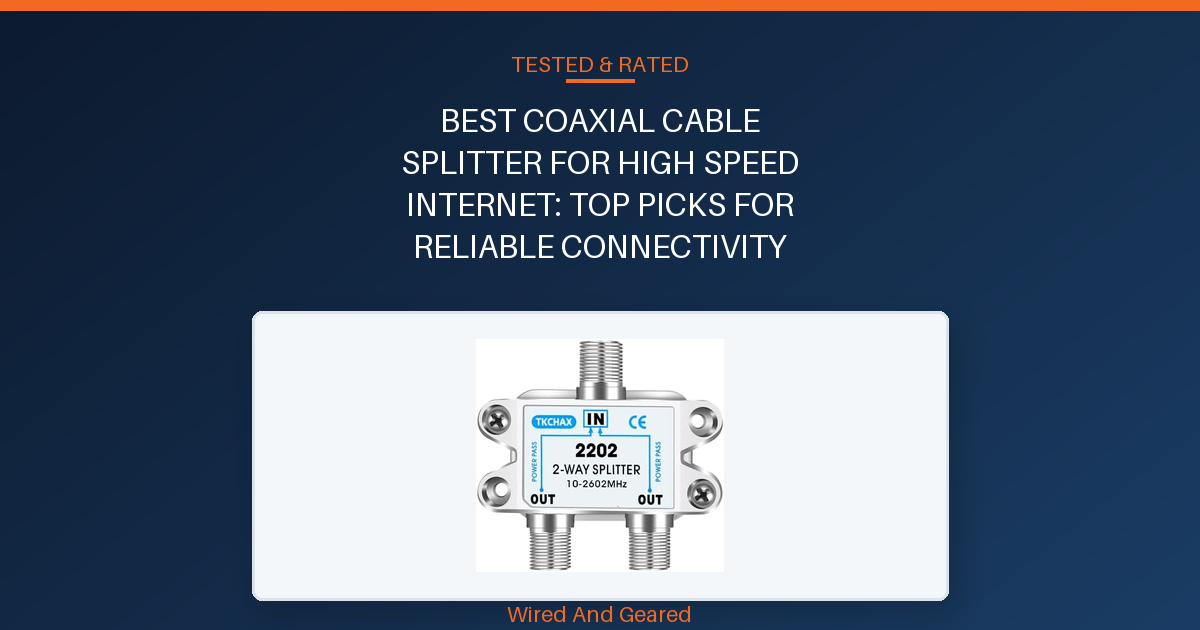
2 Way Coaxial Cable Splitter
Designed for modern networks, this splitter supports MoCA 2.5 and 3.0 protocols and covers a wide frequency range from 10 MHz to 2602 MHz. Homes relying on coax for wired Ethernet or high-speed internet see strong performance, one owner measured a 100 Mbps speed improvement after replacing an ancient splitter.
The internal PCB and nickel-plated zinc housing reduce signal loss and interference, preserving quality across all connected devices. Power-pass enabled ports ensure compatibility with amplifiers and powered antennas, so multi-room setups remain uninterrupted.
Installation is straightforward, with grounding screw ports and mounting holes for secure placement. The signal remains consistent with no noticeable drop in passthrough speed, and up to four TVs can receive clear channels from a single antenna.
This splitter is ideal for buyers who need reliable MoCA networking or strong internet distribution across older homes. It is less suited to those with basic TV-only setups, as the advanced features may be unnecessary for simple applications.
Strengths
- Supports MoCA 2.5 and 3.0 for wired Ethernet over coax
- Wide 10-2602 MHz frequency range
- Power-pass enabled ports for amplifiers
- Improves internet speed and signal reliability
- Solid construction with nickel-plated zinc housing
- Easy to install with grounding screw and mounting holes
Trade-offs
- Advanced specs unnecessary for basic TV splits
- Price may be higher than simple splitters
- Bulkier than basic models
GE Digital 2-Way Coaxial Cable Splitter
The GE Digital 2-Way Splitter handles basic TV, antenna, and older internet setups well, delivering stable signals with minimal loss. Its gold-plated connectors resist corrosion, keeping connections intact over time, and installation is quick thanks to its straightforward design.
Owners consistently report clear picture and sound on two TVs, even when split from a single attic antenna, and it maintains performance for months in most homes. Compatibility is broad, covering all brands and many device types, making it a practical choice for simple cable or antenna splits.
However, this splitter falls short with modern internet configurations, pixelation and failure to lock occur on DOCSIS 3.1 OFDM and MoCA 2.x networks, especially after updates to Xfinity’s 10G system. When used for high-speed internet, ripple noise in the critical 1000-1200 MHz range can cause connection drops and frustration.
For buyers who need a budget-friendly, easy solution for TV or antenna signal distribution, this splitter fits the bill. It is not suitable for those running MoCA 2.x/3.x or DOCSIS 3.x setups, as it cannot reliably maintain high-frequency signal integrity needed for fast, stable internet.
Strengths
- Maintains clear TV signal on two outputs
- Corrosion-resistant gold-plated connectors
- Works with all brands and RG6 cables
- Easy to install and use
- Affordable price
Trade-offs
- Fails with MoCA 2.x and DOCSIS 3.x setups
- Ripple noise disrupts internet in the 1000-1200 MHz range
- Signal drops after recent Xfinity updates
GE Digital 4-Way Coaxial Cable Splitter
The GE Digital 4-Way Splitter excels at feeding up to four TVs from a single antenna or cable line, with buyers reporting zero issues with picture quality or FM reception even when splitting the signal three or four ways. Its gold-plated connectors resist corrosion, and installation is simple, existing satellite or attic wiring can be repurposed for OTA (over-the-air) signals without loss.
Signal loss is minor, and users consistently achieve clear reception across multiple rooms. The splitter’s power pass feature keeps amplified antennas or cable modems connected, so there are no interruptions for streaming or internet upgrades.
It is well-suited for cord-cutters who want to maximize free local channels and streaming services by connecting several TVs to one outdoor or attic antenna. While performance is strong, the price is slightly higher than similar splitters, and those with only one or two TVs may not need the extra ports.
This splitter is best for homes with three or four TVs where reliable signal distribution matters.
Strengths
- Feeds up to four TVs with clear reception
- Corrosion-resistant gold-plated connectors
- Works with RG6 and RG59 cables
- Minimal signal loss across all outputs
- Easy repurposing of satellite/antenna wiring
Trade-offs
- Price is higher than basic splitters
- Extra ports unnecessary for smaller setups
- Bulky for tight spaces
Digital 8-Way Coaxial Cable Splitter Compatible with RG6
The Digital 8-Way Coaxial Splitter is built for large setups requiring eight outputs, such as vintage electronics or whole-home signal distribution. Its frequency range spans 5 to 2400 MHz, matching both modern and retro devices, and all ports are power-pass enabled for amplifiers or powered antennas.
Bidirectional capability means it can handle both input and output signals smoothly, useful for satellite and broadband feeds. Transmission is stable and noise-free, with reviewers noting no signal loss across multiple devices.
However, the splitter is lightweight and less solid than 1980s and 1990s models, so durability may be a concern for permanent installations. Measuring 5.25 inches long, it fits most setups but may require extra mounting support.
This splitter is best for enthusiasts splitting signals to several vintage or modern devices. It is not ideal for those wanting a heavy-duty, long-lasting splitter, as the construction is less strong than legacy products.
Strengths
- Eight outputs for multi-device connections
- Wide 5-2400 MHz frequency range
- Power-pass enabled on all ports
- Bidirectional transmission
- Stable, noise-free signal
Trade-offs
- Lightweight build is less durable
- Not as high quality as legacy splitters
- Large footprint may not suit tight spaces
BAMF 2-Way Coax Cable Splitter – Bi-Directional MoCA 5-2300
The BAMF splitter is engineered for modern homes needing stable internet and TV signals, supporting a wide 5-2300 MHz range that covers MoCA networks, DOCSIS modems, and streaming devices. Owners see improved signal strength, reduced Xfinity blackouts, and no picture loss on TVs or portable devices.
Its zinc-alloy, nickel-plated housing resists corrosion and withstands outdoor or indoor conditions, making it a durable choice. Installation is quick, and the unit reliably splits signals with minimal drop, MoCA adapters and wired Ethernet over coax perform as expected, and TV antenna reception is noticeably steadier than with cheaper splitters.
While all ports are labeled power-pass, reverse powering for pre-amplified antennas is inconsistent and may fail for certain uses. The product is backed by a one-year warranty and responsive support for replacements.
This splitter is best for buyers needing MoCA compatibility and strong, stable internet signals without packet loss. It is less suited for those requiring reverse power pass for amplified antennas, as this feature is only partially supported.
Strengths
- Wide 5-2300 MHz frequency range for MoCA and DOCSIS
- Bi-directional design supports internet and TV
- Heavy-duty zinc-alloy, nickel-plated housing
- Improves signal strength and reduces outages
- Easy installation and reliable performance
- One-year warranty and US-based support
Trade-offs
- Reverse power pass does not work for all amplified antennas
- Priced higher than basic splitters
- Bulkier than standard models
01Frequency Range
A splitter for high-speed internet needs to support frequencies above 2 GHz. Lower-frequency splitters work for TV but can throttle modern DOCSIS or MoCA signals. Always check the specs for at least 2000 MHz or higher, using an old 750 MHz model is a common mistake.
02MoCA and DOCSIS Compatibility
MoCA 2.5/3.0 and DOCSIS 3.x support are essential for today’s cable internet and mesh networks. Many splitters still only market for HDTV, so verify compatibility with your modem and MoCA devices. If you skip this, you’ll risk signal loss and dropped connections.
03Number of Outputs
More outputs increase signal loss. For internet, use the fewest possible splits, 2-way is ideal. Only pick 4-way or 8-way splitters if you truly need to connect multiple TVs and are willing to accept lower data speeds.
04Build Quality and Shielding
Solid metal housing and secure F-type connectors block interference from nearby electronics. Flimsy construction leads to loose connections and signal degradation. Look for zinc die-cast or nickel-plated splitters, and avoid units with plastic housings.
05Bidirectional Support
Modern internet and MoCA networks require bidirectional transmission (upstream and downstream). Some older or cheap splitters only handle one direction, which will break internet or home networking. Confirm the splitter is labeled as bidirectional before buying.