
Choosing the right flash changes how your photos look, from portraits to events. The best digital camera flash lets you control light, freeze action, and avoid harsh shadows, without slowing you down.
This guide is for anyone upgrading from built-in flash or stepping up to external speedlights, whether you shoot with Canon, Nikon, or a mix. It covers the flashes that work reliably, deliver consistent results, and handle real-world demands.
Every product here stands out for power, compatibility, and ease of use, not just specs. You’ll see clear verdicts, who each flash is for, and where each one falls short.
Scan the key takeaways or buying guide if you want the essentials. The detailed comparison and FAQ cover common buying questions and setup tips.
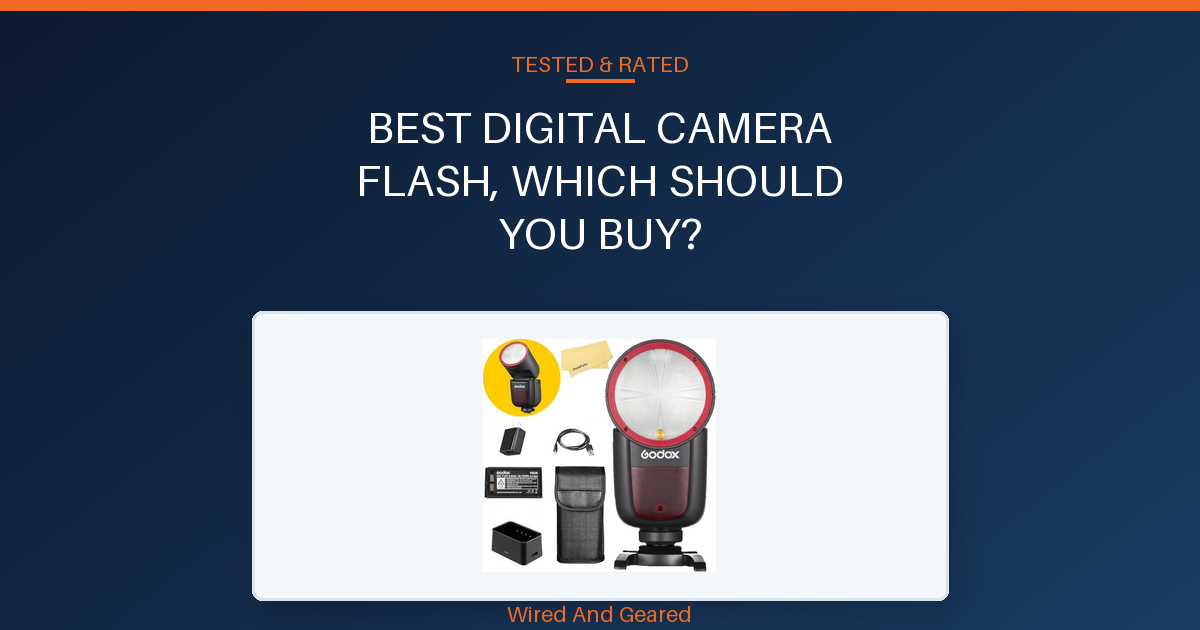
Our overall best pick: GODOX V1 V1-C V1C Godox Flash for Canon Flash Speedlite →
| Product | Guide Number | Battery Type | Head Adjustment | TTL Support | |
|---|---|---|---|---|---|
| GODOX V1 V1-C V1C Godox Flash for Canon Flash Speedlite | Not listed, comparable to 76Ws | Rechargeable Li-ion, 2980mAh | Full tilt and swivel (round head) | Yes, TTL and HSS | See on Amazon |
| ULANZI SL03 Camera Mini Flash | GN8 | Built-in rechargeable (USB-C) | 90° tilt | No, manual only | See on Amazon |
| Godox TT600 2.4G Wireless Flash Speedlite Master/Slave Flash | GN60 | 4 AA batteries | Full tilt and swivel | No, manual only | See on Amazon |
| Nikon SB-700 AF Speedlight Flash for Nikon Digital SLR | GN28 (at 35mm, ISO 100) | 4 AA batteries | Full tilt and swivel | Yes, i-TTL | See on Amazon |
| NEEWER Z2PRO-N 2.4G TTL Round Head Flash Speedlite | 76Ws (manufacturer spec, GN not stated) | 7.2V/3000mAh lithium (USB-C charging) | 330° rotation, -7° to 121° tilt | Yes, TTL and HSS | See on Amazon |
GODOX V1 V1-C V1C Godox Flash for Canon Flash Speedlite
The V1’s round head produces soft, even light with smooth falloff, outperforming rectangular speedlights for portraits and macro work. Its magnetic modifier system allows quick attachment of bounce cards and diffusers, speeding up real-world adjustments.
Battery life is a standout, with up to 480 full-power shots on a single charge, and recharge times are fast enough for long sessions. TTL and HSS support ensure smooth exposure control and high-speed shooting outdoors or in tricky lighting.
The flash head tilts and rotates for bounce and directional lighting, and the unit works both on- and off-camera with the Godox wireless X system. The build quality is strong, though the flash is larger than entry-level units.
The included battery charger is compact, and the replacement hot shoe is a useful backup. The main recurring complaint is the bounce card magnet, which can detach easily, but this does not affect core flash performance.
The V1 is best for Canon shooters needing reliable TTL, beautiful light, and accessory flexibility. Price is higher than basic flashes but justified by the feature set and performance.
Strengths
- Round head creates soft, natural light
- Magnetic modifier system for fast adjustments
- Long-lasting, rechargeable battery (480 flashes)
- TTL and HSS support for automatic exposure and high-speed sync
- Works on- and off-camera with Godox wireless system
- Intuitive setup and strong build quality
Trade-offs
- Bounce card magnet can detach easily
- Higher price than basic models
- Large size adds weight to gear
ULANZI SL03 Camera Mini Flash
The SL03 stands out for its portability; it is smaller than most thumb drives and slips easily into a pocket or camera bag. Its rechargeable battery eliminates the hassle and expense of AA batteries, making it ideal for casual outings or quick fill flash in low light.
The 90-degree adjustable head enables simple bounce lighting indoors, softening shadows without overexposure. Four brightness levels help dial in exposure for close-up portraits or small spaces, but the guide number (GN8) is modest compared to larger flashes, limiting its reach in big rooms or outdoors.
Compatibility is a major concern. The SL03 only works with cameras featuring a single-contact hotshoe, excluding many newer Sony, Canon, and Fuji models, as well as several entry-level bodies.
Users report frustration with unclear listings and the need to tweak settings, especially on Fuji bodies, which require manual sync and mechanical shutter for reliable firing. For compatible cameras, setup is straightforward, but for others, the flash simply does not fire.
Durability is mixed. While the unit performs reliably for most, some report diffuser singeing after just a few full-power flashes.
The flash maintains brightness but may lose lifespan if repeatedly pushed to max power. Its performance is best in small, enclosed spaces; outdoors or in large rooms, the reflection and fill effects are minimal.
This is not a professional or event flash, but a solid backup or EDC option for hobbyists.
Strengths
- Extremely small and lightweight
- Rechargeable battery, no AA needed
- Easy to use as fill flash or continuous light
- Quick recycling time after each shot
- 90-degree adjustable head for indoor bounce
- Works well as a backup or daily carry
Trade-offs
- Strict compatibility, excludes many camera models
- Low GN8 power limits reach and bounce outdoors
- Diffuser may singe after repeated full-power use
Godox TT600 2.4G Wireless Flash Speedlite Master/Slave Flash
The TT600’s GN60 output rivals much pricier flashes, offering strong illumination for both indoor and outdoor shooting. Its 2.4G wireless X system enables remote triggering, group control, and high-speed sync (with compatible triggers), making it versatile for off-camera lighting setups, ideal for portraits, events, and creative effects.
The flash head tilts and swivels for bounce lighting, and the large LCD makes manual adjustments straightforward, though the menu abbreviations require some learning. Battery life is solid with up to 230 full-power flashes, but it relies on four AA batteries (not included), so rechargeable cells are highly recommended to avoid extra costs.
Recycle times range from 0.1 to 2.6 seconds, keeping pace with fast-paced shoots. While TTL is absent, this simplifies operation for those comfortable with manual control.
Multi mode supports stroboscopic effects, and the unit is compatible with most major camera brands via standard hotshoe. Build quality is reliable, and the included case protects the flash well.
Some report accidental powering on when packed loosely, so using the provided bag is advised. Off-camera use requires a separate trigger or adapter, which adds expense.
The TT600 is not suitable for those wanting plug-and-play automatic exposure or TTL metering, but excels for photographers learning manual flash or needing strong wireless control.
Strengths
- GN60 high power suitable for large spaces
- 2.4G wireless system enables remote and group control
- Fast recycling (0.1-2.6s)
- Clear LCD for easy manual adjustments
- Compatible with most camera brands
- Durable build, includes protective case
Trade-offs
- No TTL, manual only
- Requires 4 AA batteries (not included)
- Off-camera setup needs additional trigger
Nikon SB-700 AF Speedlight Flash for Nikon Digital SLR
The SB-700’s i-TTL system ensures consistent, automatic flash exposure, making it nearly effortless for both beginners and experts. Its head tilts and swivels freely, allowing bounce lighting in any direction and softening harsh shadows.
Wireless flash control lets it operate as a commander or remote, and the quick-access knob streamlines switching between modes. Battery life is reliable, with AA support for easy swaps during extended shoots.
Power output is more than sufficient for portraiture and small events, sometimes even too strong at close range. Users report effective lighting at up to 30 feet, and the flash maintains stable color temperature throughout its range.
The unit is smaller and lighter than Nikon’s SB-900, with improved usability and faster mode changes. Build quality is solid, and Nikon’s service is responsive if repair is needed.
The SB-700 is well-suited for both on- and off-camera use, pairing smoothly with other Nikon speedlights in multi-flash setups. It’s backed by years of reliability, though the price is higher than generic models.
Anyone needing maximum power for large venues should look elsewhere, but for most Nikon shooters, this is the go-to upgrade from the built-in flash.
Strengths
- I-TTL automatic exposure for Nikon cameras
- 360-degree head adjustment for versatile bounce
- Wireless commander/remote operation
- Quick mode switches and intuitive controls
- Reliable AA battery performance
- Strong build quality with good service support
Trade-offs
- Price higher than third-party options
- Occasionally too powerful at close range
- Bulkier than entry-level flashes
NEEWER Z2PRO-N 2.4G TTL Round Head Flash Speedlite
The Z2PRO-N delivers 76Ws of flash power with rapid 1.5-second recycle times and up to 600 full power flashes per charge, easily handling portraits and event photography. Its round head provides smoother, more natural light, and the built-in dual LED modeling lamps with 11 brightness levels preview fill and shadow placement.
The upgraded UI and TCM shortcut key simplify toggling between TTL and manual modes. Wireless flexibility is a highlight, supporting both NEEWER Q and Godox X systems (though not simultaneously), covering up to four groups and 32 channels with a 100-meter range.
The head rotates 330 degrees and tilts from -7 to 121 degrees, supporting bounce and directional lighting. Battery life is excellent, with 7.2V/3000mAh lithium lasting multiple shoots, and USB-C charging is fast and convenient.
Build quality is solid, but the unit is bulkier than entry-level flashes. Some users report missing diffuser accessories; others praise compatibility with Godox triggers for smooth integration.
The main drawback is the need to update firmware for certain Nikon models and to ensure full TTL accuracy. This flash is best for users who want maximum power, wireless flexibility, and cross-brand trigger support.
Strengths
- 76Ws power handles portraits and events
- Fast 1.5s recycling and 600 full power flashes per charge
- TTL and HSS support for automatic and high-speed shooting
- Wireless compatibility with NEEWER and Godox systems
- Dual LED modeling lamps with adjustable brightness
- USB-C charging, long battery life
Trade-offs
- Bulky compared to entry-level flashes
- Firmware updates needed for some Nikon models
- No included diffuser
01Camera compatibility
Always check if the flash supports your camera’s brand and model, especially for TTL and wireless features. A mismatch can disable automatic exposure or cause triggering errors. Avoid generic flashes without brand-specific versions if you rely on TTL or remote control.
02Power (guide number)
Guide number reflects the maximum output and range. For indoor events or large rooms, choose a flash with a guide number above 50. Lower-powered flashes struggle to freeze action or illuminate groups, leading to dim or uneven results.
03TTL vs. Manual control
TTL (Through The Lens) lets the camera set flash power automatically, saving time in changing conditions. Manual flashes give you full control but require frequent adjustment. For fast-paced or unpredictable shoots, TTL is a must; don’t skip it if consistency matters.
04Recycling speed
Recycle time is how quickly the flash is ready after firing. For event, action, or group shots, aim for under two seconds. Slow recycling causes missed moments and frustration, especially in multi-shot bursts.
05Wireless and modifier options
Wireless triggering allows off-camera placement and creative lighting setups. Look for flashes with built-in wireless or easy integration. Magnetic or snap-on modifiers simplify diffusion and color control, speeding up your workflow. Avoid flashes with limited modifier compatibility if you want flexible lighting.
06Flash head tilt and swivel
A flash head that tilts and swivels makes bouncing light off walls or ceilings simple. Fixed heads limit your ability to soften shadows and shape light. Always check for full rotation and tilt if you want professional-looking results indoors.