
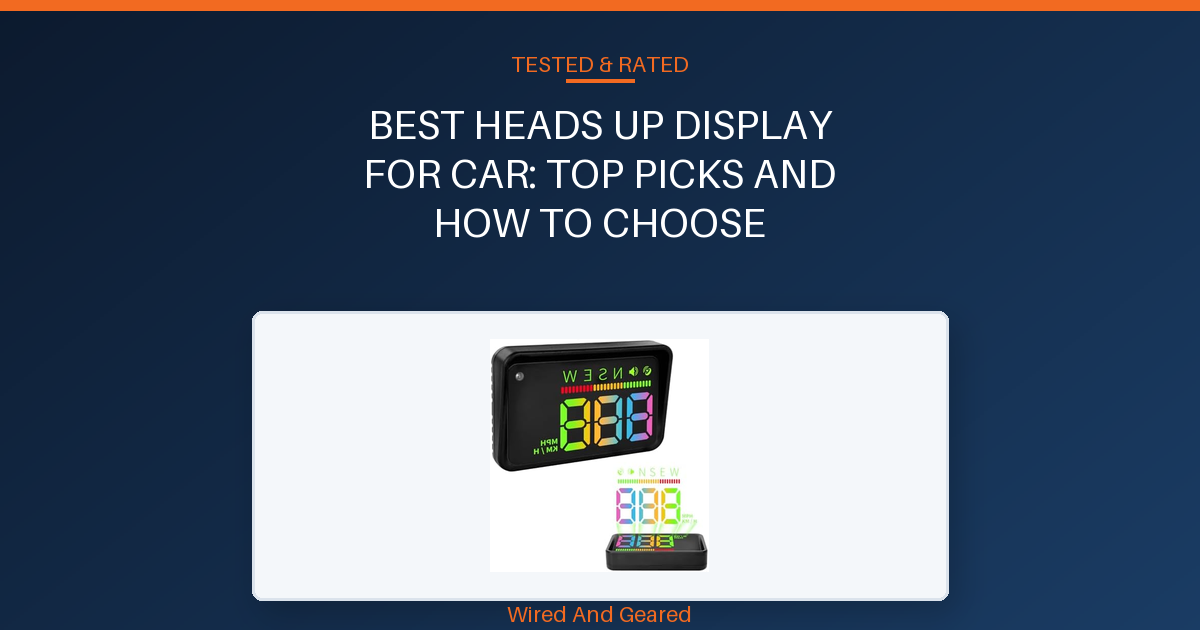
Choosing the right heads up display for your car directly impacts how safely you monitor speed and travel information. This guide is for drivers who want clear, real-time data projected in their line of sight without distracting clutter or unreliable readings.
Each HUD featured here has been evaluated for visibility, accuracy, installation ease, and extra features, so you can quickly compare what matters most. Focus on your typical driving habits and vehicle type to match the HUD to your needs.
If you prioritize simple speed readouts with minimal fuss, look for GPS-based models with proven clarity. More technical users or car modders may prefer OBD2-connected HUDs for expanded data.
Every recommendation here is based on persistent performance and practical trade-offs, not just specs. Scan the table, check the buying guide for key criteria, and use the FAQs to answer what most buyers ask.
TL;DR: The Heads up Display for Cars, Car HUD, GPS Speedometer (index 3) stands out for its reliable speed projection, clear visibility, and consistent GPS signal in all conditions. The wiiyii OBD2 Gauge Display Head Up Display (index 2) is the runner-up, offering deep engine data for drivers who want more than basic speed and direction.
Our overall best pick: Heads up Display for Cars →
| Product | Display Type | Power Source | Speed Source | Max Speed Display | |
|---|---|---|---|---|---|
| Heads up Display for Cars | Windshield projection | USB | GPS + BDS | 115 MPH | See on Amazon |
| Heads up Display for Cars | Windshield projection | USB | GPS + BDS (32 satellites) | 115 MPH | See on Amazon |
| AZIJYV Windshield Speedometer Projector, Digital | Windshield projection | USB | GPS | Not specified | See on Amazon |
| Wiiyii OBD2 Gauge Display Head Up Display for Cars | Physical screen | OBD2 or USB | OBD2 + GPS | Not specified | See on Amazon |
| Car Wireless Headup Display Solar GPS Digital Speedometer | Physical screen | Solar + USB | GPS | Not specified | See on Amazon |
Heads up Display for Cars
Installation is simple with USB power and a plug-and-play design, suitable for cars, motorcycles, and trucks. The large-font display is easily readable for older drivers or those wearing sunglasses, and the metal shading technology eliminates most unwanted reflections.
Auto brightness ensures comfortable viewing whether in bright daylight or at night. Speed is accurate within 0.6-1.8 MPH, matching industry standards for GPS HUDs.
The device is responsive to changes in ambient light and displays speed in MPH by default. Switching between miles and kilometers is straightforward, and the base sits securely without adhesive.
The speed alarm is set at 75 MPH by default but can be adjusted or muted, which is useful for highway driving. Signal reception is stable under normal conditions, but high-altitude environments (above 6000 feet) may cause the unit to blank out.
Initial satellite lock can take some time, especially during first use. If your vehicle has a metal explosion-proof film on the windshield, signal reception may be affected.
Units occasionally fail to connect without obvious cause, so reliability is not perfect.
Strengths
- Clear, large-font speed display readable in all lighting
- Auto brightness adapts for day and night
- Plug-and-play USB installation
- Speed alarm is adjustable or can be muted
- Stable signal reception in most areas
Trade-offs
- Fails above 6000 feet altitude
- Occasional satellite connection issues
- Sensitive to windshield coatings
Heads up Display for Cars
Plug-and-play setup means you can install this HUD in minutes, even in vehicles lacking an OBD port. The large, anti-reflective display is readable in all lighting conditions, from bright sunlight to nighttime, thanks to its well-calibrated auto brightness.
For older cars with hard-to-see speedometers, this unit eliminates the need to glance down or stretch your neck, providing a clear speed readout right where you need it. Accuracy is solid, with deviations consistently reported at 1-2 mph, well within the range of most GPS-based HUDs.
The device powers on and off with your car, and you can leave it plugged in without worrying about draining the battery. The speed is displayed in MPH by default, with a maximum of 115 MPH, making it suitable for most US vehicles.
The unit works best in open areas with a clear satellite signal and rarely needs its reflective film, as the numbers remain readable without it. Drawbacks include a short power cord that may require replacement for cleaner installation, and some minimal blurring or misalignment depending on your dash angle.
While build quality is generally good, a few reviews mention occasional signal loss under dense trees or hills. If you require real-time speed precision or drive in signal-challenged environments, this device may not meet your needs.
Strengths
- Large, easy-to-read speed display visible even in bright sunlight
- Auto brightness adapts well for day and night driving
- Plug-and-play USB power, no OBD port required
- Accurate within 1-2 MPH under normal conditions
- Works with most cars, trucks, and motorcycles
Trade-offs
- Short power cord limits wire routing options
- Occasional signal loss in hilly or dense areas
- Slight deviation (up to 2 MPH) from true speed
AZIJYV Windshield Speedometer Projector, Digital
The AZIJYV M22 projects speed, clock, travel time, and compass onto your windshield, offering a fighter-pilot vibe. Installation is straightforward and plug-and-play, and the unit powers on and off automatically with your car.
The display is bright enough for daytime use but struggles with double vision and glare in direct sunlight, especially if the supplied film isn’t applied correctly. Speed accuracy depends heavily on initial calibration and settings; default readings may show a 2-10 MPH difference compared to your car’s speedometer.
Most users find it necessary to adjust settings or accept a minor offset, particularly above 60 MPH, where discrepancies widen to 3-4 MPH. Satellite lock is generally quick (within 10 seconds), but a metalized windshield or multiple GPS devices can interfere with signal acquisition.
The over speed alarm can be helpful but may become annoying if not set properly. Adhesive tape quality is a weak point, with some units failing to stick securely.
The compass feature is unreliable, and instructions are confusing, making setup more difficult than competitors. If bright sunlight is a constant in your area, legibility is a concern.
Strengths
- True windshield projection for speed, time, and compass
- Plug-and-play installation
- Over speed alarm adds safety
- Quick satellite signal lock (under 10 seconds)
- Customizable display modes
Trade-offs
- Requires calibration for accurate speed
- Double vision and glare in bright sunlight
- Weak adhesive and unreliable compass
Wiiyii OBD2 Gauge Display Head Up Display for Cars
The wiiyii P6 stands out for its ability to display not just speed but also real-time engine data like coolant temperature, oil temperature, voltage, RPM, and more. Plugging into the OBD-II port gives you access to over 100 types of data, and the display can be mounted on the dashboard or windshield.
Ambient lighting automatically adjusts brightness, and the color changes (blue to red) for alarms such as speeding. Installation is simple, with a long cable allowing flexible placement.
The display is bright and readable even under strong sunlight, and the device powers off automatically when the engine shuts down (if voltage is set correctly). For vehicles without OBD2, the unit falls back to GPS-only mode, which limits data but maintains basic speed display.
Programming takes some patience, and not all gauge options are customizable. Stability is generally good, but mounting quality is inconsistent, sometimes requiring additional adhesive.
Compatibility can be an issue for older vehicles with non-standard OBD protocols, and battery voltage fluctuations can interfere with auto-off logic. If your priority is a minimalist speed-only HUD, this device may feel feature-heavy and distracting.
Strengths
- Displays speed, engine temperature, RPM, voltage, and more
- Dual-mode OBD + GPS for richer data
- Ambient lighting adapts brightness automatically
- Long cable for flexible placement
- Easy plug-and-play installation
Trade-offs
- Mount may require extra adhesive for stability
- Compatibility issues with some OBD2 vehicles
- Programming and gauge customization can be confusing
Car Wireless Headup Display Solar GPS Digital Speedometer
The B0CK2B7C5Q HUD is small enough to fit unobtrusively on the dash and uses a sticky pad for mounting, which is convenient for leased vehicles. Speed accuracy is strong, with users reporting consistent readings even when factory speedometers are offset by as much as 14 MPH.
The unit displays time, temperature, altitude, and speed, with the LCD screen offering large fonts for easy visibility. Solar charging is a standout feature, providing long battery life and reducing reliance on a USB connection.
The panel intelligently adjusts for brightness, keeping the screen readable in most conditions, though some glare is present in direct sunlight. Overspeed and fatigue alarms are built in, enhancing safety on longer drives.
Installation is straightforward, and setup takes only a few minutes. The product’s 24-hour clock cannot be changed to 12-hour format, which may annoy some users.
Solar charging is not fully reliable in cloudy conditions, leading to blinking or shutdowns. The sticky pad may leave residue on the dash, and the screen can be hard to read in bright sunlight due to glare.
Sellers’ return policies vary, so check before purchase if buying from third-party vendors.
Strengths
- Accurate speed display even with offset factory speedometers
- Solar-powered with USB backup for flexible charging
- Displays time, temperature, and altitude
- Compact design for unobtrusive dash placement
- Easy installation and quick setup
Trade-offs
- 24-hour clock format not adjustable
- Glare makes screen hard to read in direct sunlight
- Solar charging may be unreliable in cloudy conditions
01Visibility and projection clarity
A clear, easy-to-read display is essential for safe driving. Check for models with proven brightness and contrast so the speed remains visible in direct sunlight and at night. Avoid displays that wash out or require you to squint or refocus, especially if you wear glasses.
02GPS and signal reliability
Consistent signal reception ensures your HUD always displays accurate speed and direction. Test models in varied environments, urban, rural, tunnels, to confirm readings don’t drop out or lag. Many buyers overlook this, but unreliable GPS ruins the purpose of a HUD.
03Installation and calibration
Easy installation saves time and frustration. Look for HUDs that require minimal wiring or calibration, especially if you drive multiple cars. Avoid units that need frequent recalibration after windshield repairs or angle changes, as this can become a recurring hassle.
04Data features and connectivity
Consider what information you really need. OBD2-connected HUDs provide engine diagnostics and more, but require vehicle compatibility and extra setup. If you only care about speed, GPS-only models are simpler and less prone to technical issues.
05Size and placement
A HUD should be large enough to read quickly, but not so big that it blocks your view. Choose the smallest size that works for your dashboard and seating position. Oversized HUDs can compromise safety by interrupting your forward visibility.